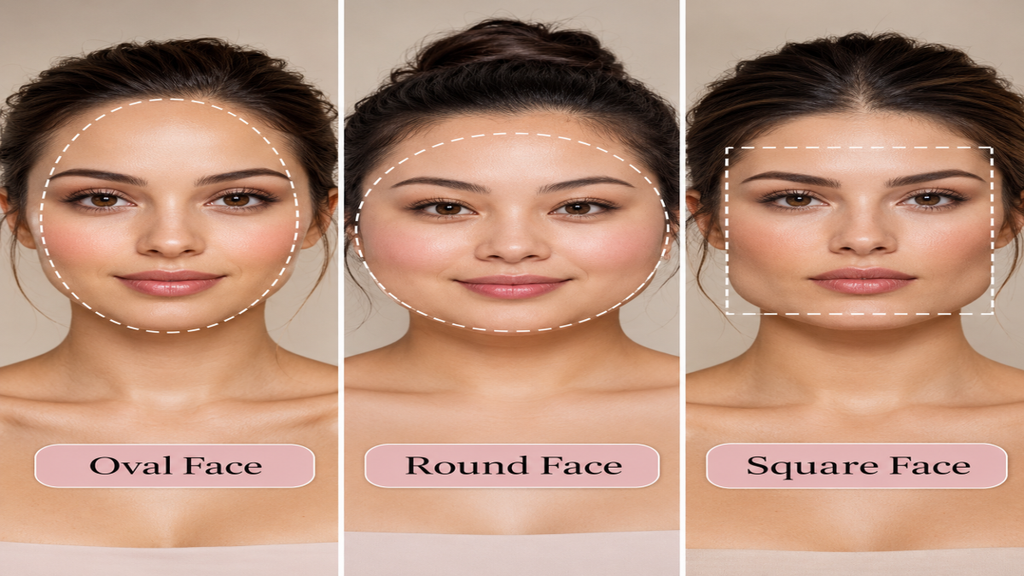
Have you ever wondered “What is my face shape?” Knowing your face shape can make choosing makeup techniques, hairstyles, glasses and accessories much easier.
Whether you have a round, oval, square, heart, diamond, oblong or triangle face understanding your natural facial proportions can help you highlight your favorite features and experiment with different beauty looks.
The good news is that learning how to determine your face shape is easier than you might think. You don’t need professional beauty tools or an expensive consultation. With a mirror, measuring tape and a few minutes you can get a clearer idea of your facial structure.
In this beginner-friendly guide we’ll explain how to find your face shape in three easy steps recognize seven common face shapes and choose makeup techniques that complement your features.
Table of Contents
What Is a Face Shape?
Your face shape refers to the overall outline and proportions of your face. It is influenced by the relative width of your forehead, cheekbones and jawline along with the length of your face.
Although every face is unique, beauty and hairstyling guides often group facial outlines into seven common categories:
- Oval
- Round
- Square
- Heart
- Diamond
- Oblong or rectangular
- Triangle or pear-shaped
Many people have features that overlap between two categories. For example your face might be mostly oval with a slightly angular jawline.
These categories are styling guides not strict rules or measures of beauty.
How to Determine Your Face Shape in 3 Easy Steps
Before starting gather a flexible measuring tape or ruler a mirror, a hair tie and a notebook.
Stand in a well-lit area pull your hair away from your face and look straight ahead. Keeping your expression relaxed will make it easier to observe your facial proportions.
Step 1: Measure Your Face Length
The first step is to measure the vertical length of your face.
- Stand directly in front of a mirror.
- Locate the center of your hairline.
- Measure straight down to the bottom of your chin.
- Record the measurement in centimeters or inches.
For example your face length might be 19 centimeters.
Face length is an important clue when identifying oval, round and oblong face shapes.
If your face is noticeably longer than it is wide you may have an oval or oblong shape. If the measurements are relatively close your face may be round or square.
However length alone cannot determine your exact face shape. You also need to examine its width and jawline.
Beauty Tip: Keep the measuring tape straight rather than following the curve of your nose. If your hairline is irregular choose a consistent central starting point.
Step 2: Measure Your Forehead, Cheekbones and Jawline
The second step is to compare the three main horizontal dimensions of your face.
Measure your forehead width
Find the widest part of your forehead usually between the temples near the upper forehead. Measure from one side to the other and write down the result.
Measure your cheekbone width
This measurement is particularly useful because the cheekbones are often the widest area of oval, round and diamond-shaped faces.
Measure your jawline width
Identify the corners of your jaw just below your ears. Compare the distance between the two jaw corners.
You can also examine whether your jawline is rounded, angular, broad or narrow.
For consistency use a straight-on photograph if a measuring tape is difficult to position. A tape following the curve of your face may give a different reading from a straight-line width.
Example measurements:
| Facial Feature Example | |
| Face length 19 cm | |
| Forehead width 13 cm | |
| Cheekbone width 14 cm | |
| Jawline width 11 cm |
In this example the face is longer than it is wide the cheekbones are the broadest area and the jawline is relatively narrow.
These characteristics could suggest an oval shape depending on the chin and overall outline.
Step 3: Compare Your Measurements and Identify Your Face Shape
Now compare your measurements and look at your face as a whole.
Ask yourself:
- Is my face longer than it is wide?
- Which area is widest: my forehead, cheekbones or jawline?
- Does my chin look rounded, pointed or square?
- Are the sides of my face curved or relatively straight?
- Does my jaw narrow noticeably toward my chin?
You can also take a clear straight-on photograph with your hair pulled back and trace your face outline digitally.
Compare the resulting outline with illustrations of common face shapes.
For example a broad forehead with a narrow pointed chin may suggest a heart-shaped face. Prominent cheekbones and a narrower forehead and jawline may suggest a diamond-shaped face.
Don’t worry if your face doesn’t fit perfectly into a single category. Identifying your dominant features is more useful than forcing an exact label.
The 7 Different Face Shapes and How to Identify Them
Now that you know how to measure your face let’s explore the seven commonly recognized facial shapes.
1. Oval Face Shape
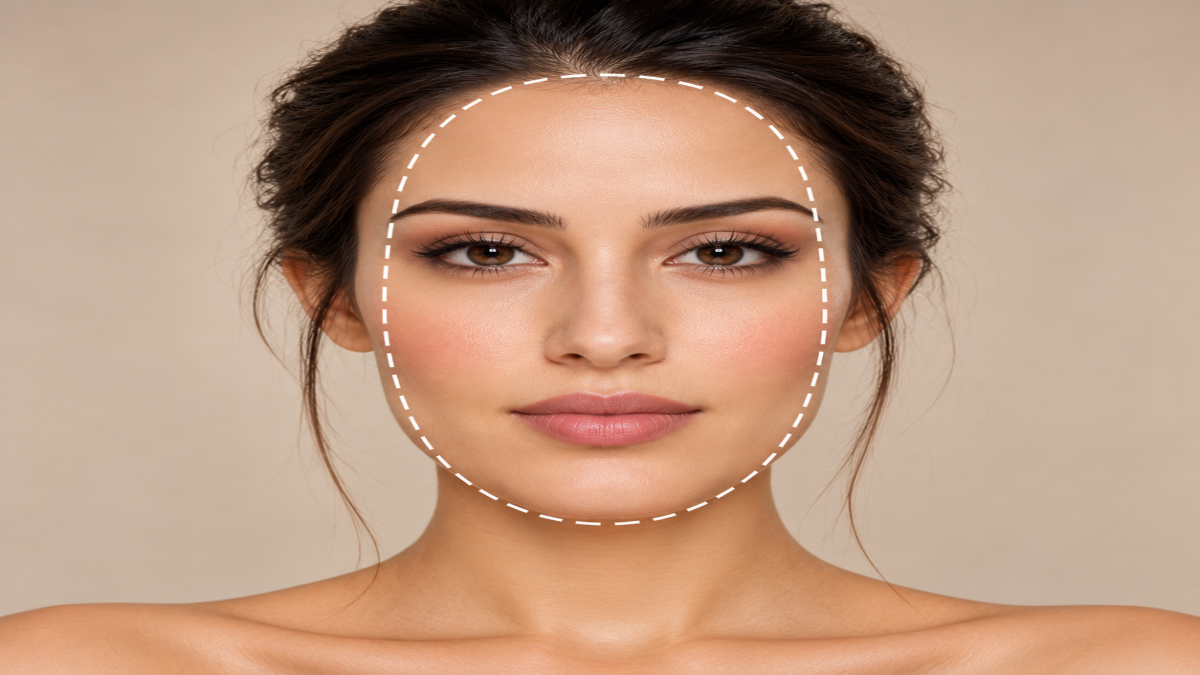
An oval face is generally longer than it is wide with balanced proportions and a gently rounded jawline.
Main characteristics:
- Cheekbones are usually the widest facial feature.
- The forehead is slightly wider than the jawline.
- The chin has a soft, rounded appearance.
- The face is moderately elongated.
Makeup tip: Experiment with softly blended contour beneath the cheekbones and blush placed along the upper cheeks. Oval faces can accommodate many placement styles.
Hairstyle idea: Layered haircuts, bobs, soft waves, and curtain bangs offer different ways to frame an oval face.
2. Round Face Shape
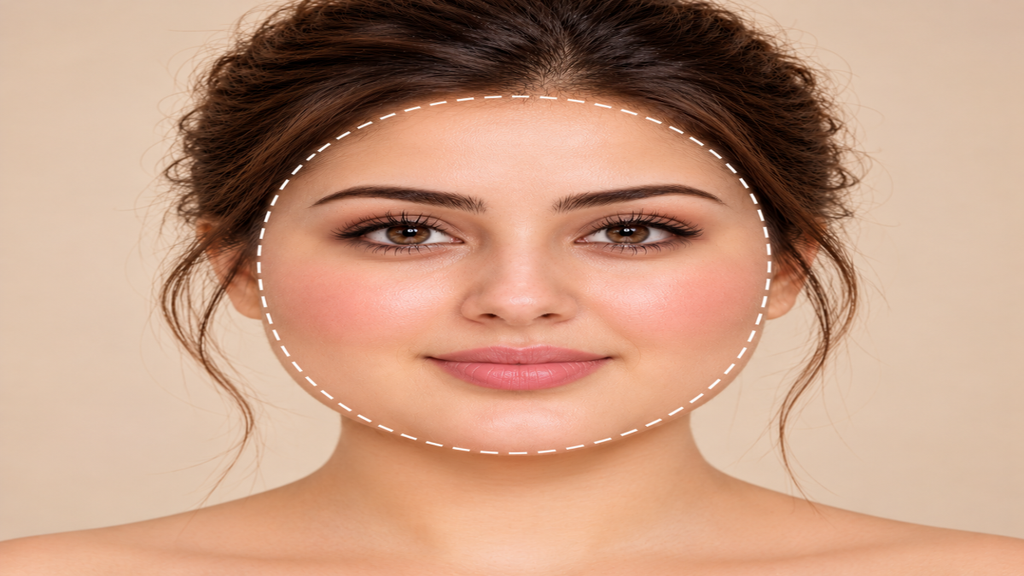
A round face usually has soft curves, fuller cheeks and a face length that is relatively close to its width.
Main characteristics:
- Full or prominent cheeks.
- Soft rounded jawline.
- Minimal sharp angles.
- Similar overall face length and width.
Makeup tip: For a more lifted appearance blend blush diagonally toward the temples. Light contouring under the cheekbones can create additional dimension.
Hairstyle idea: Long layers, side-swept bangs and styles with volume near the crown can create the appearance of added length.
3. Square Face Shape
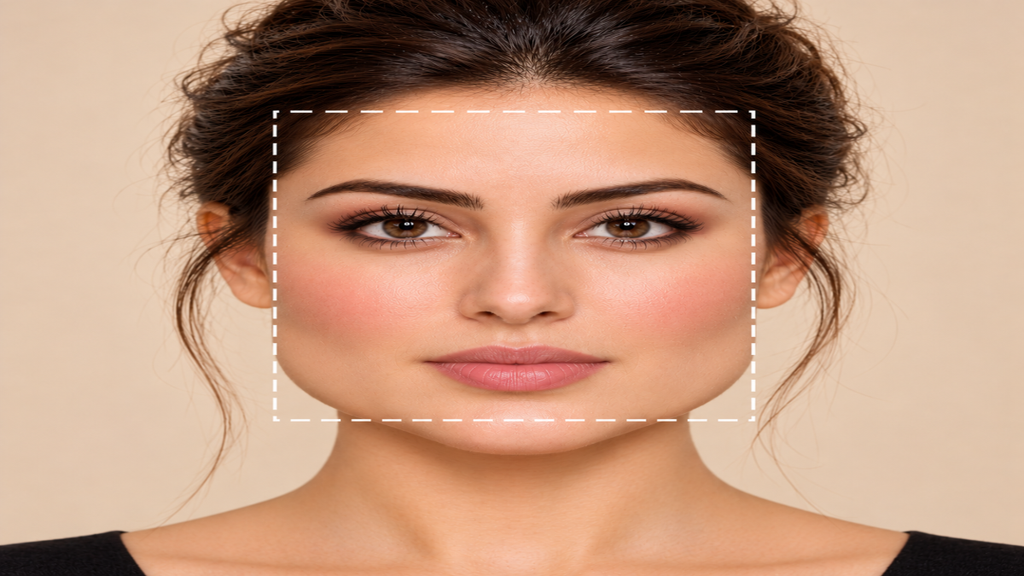
Square faces are recognized by their strong jawlines and relatively balanced forehead, cheekbone and jaw widths.
Main characteristics:
- Broad or defined forehead.
- Prominent, angular jawline.
- Relatively straight sides.
- Face width and length may be similar.
Makeup tip: Softly blend contour near the outer jaw corners if you want a diffused effect. A sweeping blush application can complement angular features.
Hairstyle idea: Textured waves, soft layers and side-parted hairstyles can create contrast with a structured jawline.
4. Heart Face Shape
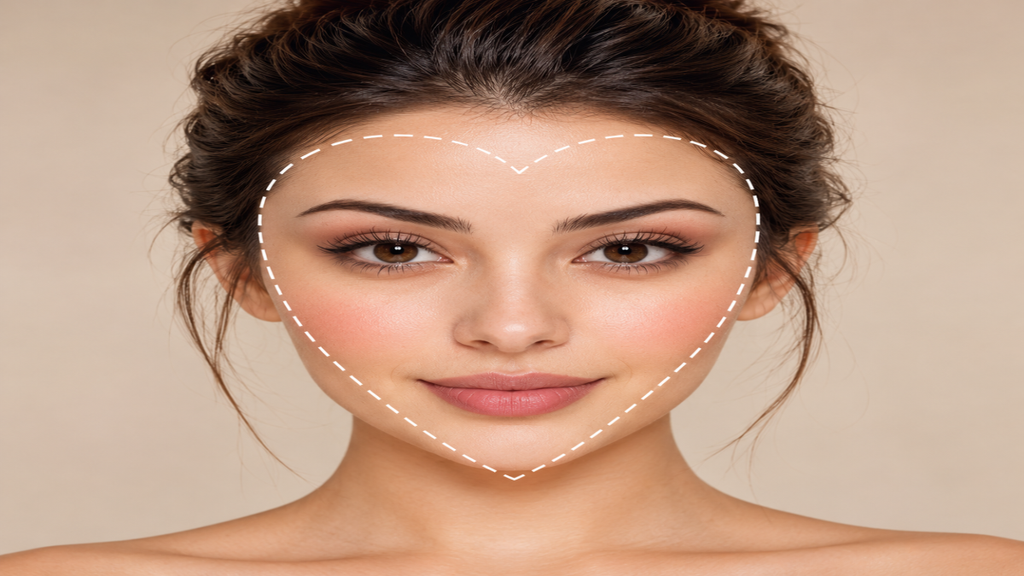
A heart-shaped face is typically broader across the forehead and upper cheeks narrowing toward the chin.
Main characteristics:
- Forehead is among the widest areas.
- Chin is relatively narrow or pointed.
- Jawline tapers downward.
- Upper face appears broader than the lower face.
Makeup tip: Keep forehead contouring light and add blush to the cheeks for a balanced look. Try a softly defined lip to draw attention to the lower face.
Hairstyle idea: Side-swept bangs, shoulder-length waves, and chin-length styles can add visual fullness around the jaw.
5. Diamond Face Shape
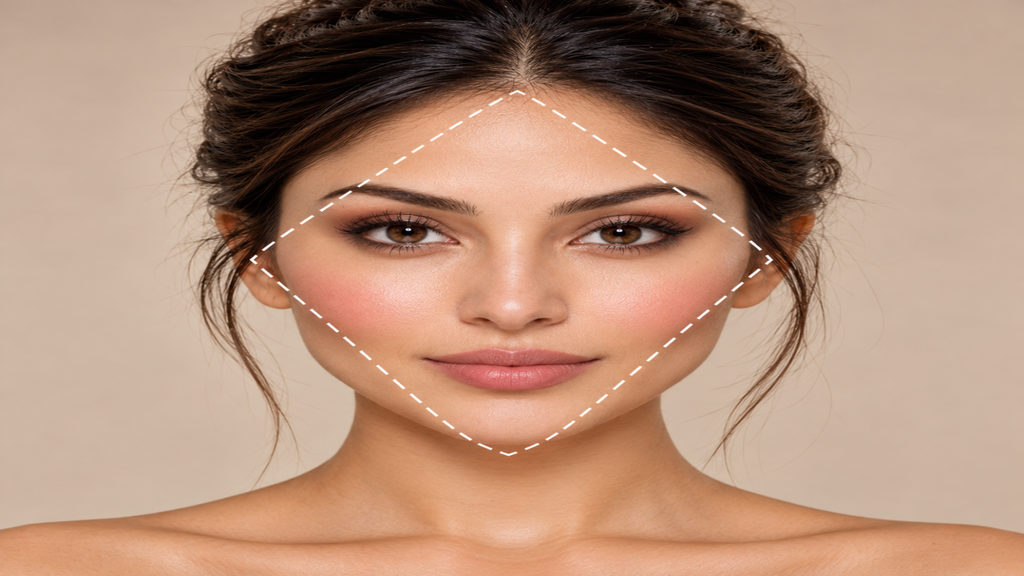
Diamond-shaped faces often have prominent cheekbones and narrower forehead and jawline proportions.
Main characteristics:
- Cheekbones are the widest area.
- Forehead is relatively narrow.
- Chin may look pointed.
- Facial outline tapers above and below the cheeks.
Makeup tip: Use highlighter sparingly on the upper cheekbones and blend blush softly. You can experiment with blush placement that doesn’t emphasize cheek width as much.
Hairstyle idea: Side-swept bangs, textured bobs and soft layers can frame the forehead and jawline.
6. Oblong or Rectangular Face Shape
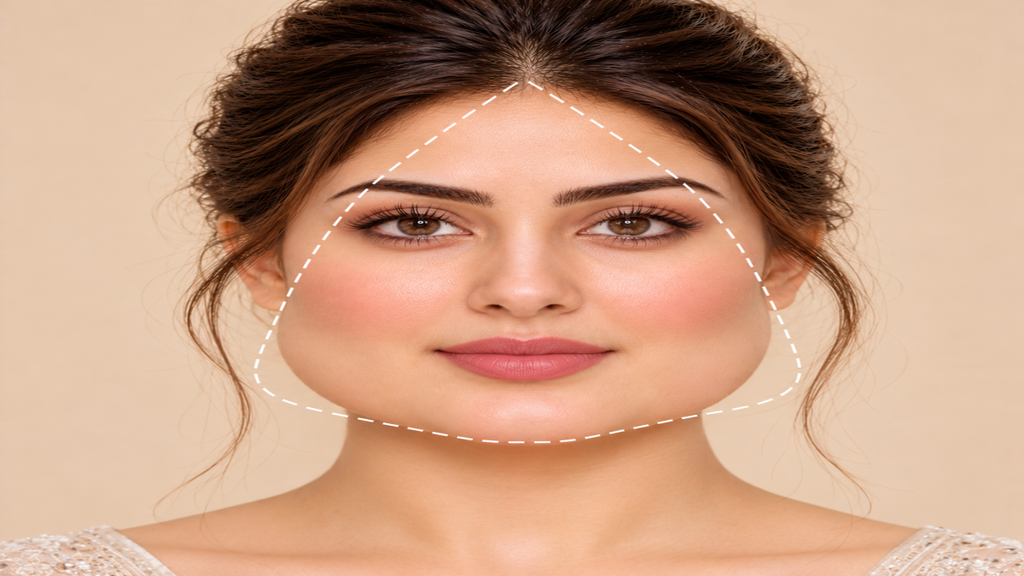
Oblong faces are noticeably longer than they are wide often with relatively straight sides.
Main characteristics:
- Face length is the dominant measurement.
- Forehead, cheekbones and jaw may be similar in width.
- Facial sides appear fairly straight.
- Chin may be softly rounded or slightly angular.
Makeup tip: Applying blush across the cheeks can emphasize width rather than length. If desired, subtle contouring near the hairline and chin can add visual balance.
Hairstyle idea: Curtain bangs, soft waves and layered cuts with side volume can help frame an elongated face.
7. Triangle or Pear-Shaped Face
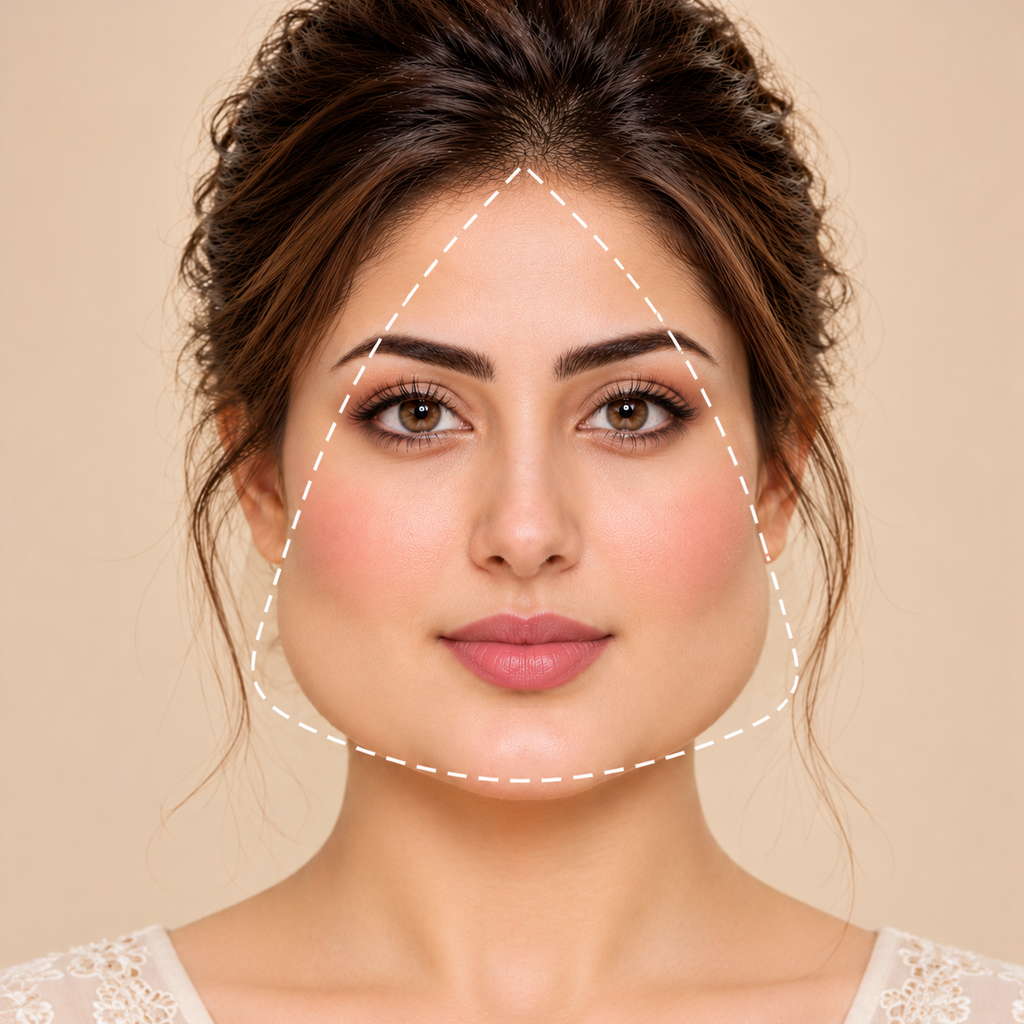
A triangle-shaped face is generally wider at the jawline than at the forehead.
Main characteristics:
- Jawline is the widest area.
- Forehead is relatively narrow.
- Cheekbones may be narrower than the jaw.
- Lower face appears broader than the upper face.
Makeup tip: Try highlighting the upper cheekbones and using softly blended eye makeup to draw attention upward. Blush placed higher on the cheeks can also create a lifted effect.
Hairstyle idea: Styles with volume around the temples, textured bangs, and layered cuts can visually balance a broader lower face.
Face Shape Comparison Chart
Still not sure which shape matches your facial structure? Use this quick comparison chart.
| Face Shape | Widest or Defining Feature | Jawline |
| Jawline | Balanced proportions often widest at cheekbones | Soft and rounded |
| Round | Full cheeks, length and width relatively close | Curved |
| Square | Forehead, cheeks and jaw similar in width | Strong and angular |
| Heart | Broad forehead and upper face | Narrow or pointed chin |
| Diamond | Prominent cheekbones | Narrow and tapered |
| Oblong | Noticeably longer than wide | Rounded or softly angular |
| Triangle | Broad lower face | Wide and defined |
Remember that these are general patterns. Real facial proportions vary and mixed characteristics are completely normal.
How to Find Your Face Shape Without Measuring
If you don’t have a measuring tape you can still identify your facial outline visually.
Start by taking a front-facing photograph with your hair pulled away from your forehead.
Keep your camera at eye level and use even lighting. Avoid extreme camera angles and very close selfies which can distort facial proportions.
Next trace your face outline using a photo-editing tool or a transparent digital drawing layer.
Look for three things: the overall length the widest horizontal area and the shape of your jawline.
Compare the outline with reference illustrations of oval, round, square, heart, diamond, oblong and triangle faces.
This approach may not provide exact measurements but it can help you recognize your dominant facial features.
Can an AI Face Shape Detector Help?
Online face shape detectors offer another way to explore your facial proportions.
These tools analyze visible features in a photograph, such as the face outline, forehead area, cheeks and jaw.
For example the Face Shape Detector website offers photo-based analysis as well as measurement-based alternatives.
For better results:
- Use a clear photograph taken from the front.
- Keep your hair away from your facial outline.
- Avoid beauty filters and extreme camera angles.
- Use balanced lighting.
- Compare the result with your own measurements.
Keep in mind that AI results are estimates not definitive assessments. Different tools may classify the same face differently.
Before using any photo-based service review its privacy information and how it handles uploaded images.
How Does Face Shape Affect Makeup Application?
Your face shape can help you decide where to place contour, blush, bronzer and highlighter.
However there is no single correct makeup style for any face shape. The best application is one that suits your personal style and desired effect.
Contouring for Your Face Shape
Contouring uses slightly deeper shades to create the appearance of shadow and dimension.
For example you can blend contour beneath the cheekbones on a round face to create a more sculpted effect. On a square face contouring around the outer jaw corners can make the outline look softer.
For an oblong face a little shading near the hairline or chin can visually shorten the face.
Always blend thoroughly to avoid harsh lines.
Blush Placement for Different Face Shapes
Blush placement can change the overall impression of your makeup.
Round faces may benefit from blush swept upward toward the temples when a lifted effect is desired.
Oblong faces can experiment with horizontal placement across the cheeks.
Heart-shaped faces can use a softly blended application that brings attention to the center of the face.
These are creative suggestions rather than rules. Try different placements to find your favorite look.
Highlighting Your Natural Features
Highlighter adds brightness to selected facial areas.
You can apply a small amount to the upper cheekbones the bridge of your nose or other points where you want a luminous finish.
If you have naturally prominent cheekbones consider using a subtle highlighter rather than an intense shimmer.
The goal is to create the finish you prefer while keeping the makeup comfortable and easy to wear.
5 Common Mistakes When Identifying Your Face Shape
A few simple mistakes can lead to confusing result.
1.Measuring with hair covering your forehead
Bangs and loose hair can hide your natural hairline. Pull your hair back before taking measurements.
2.Using a tilted selfie
A photograph taken from above or below your face can change the apparent proportions of your forehead, nose and jaw.
3.Looking only at your jawline
Jaw shape is important but forehead width, cheekbone width and face length also matter.
4.Treating measurements as exact rules
Face shape categories don’t have universally agreed numerical boundaries. Slight differences between measurements don’t automatically change your shape.
5.Believing one face shape is better than another
Every facial structure can suit a wide variety of makeup and hairstyles. Face shape should inspire styling choices not limit them.
Frequently Asked Questions About Face Shapes
1. How can I determine my face shape at home?
Measure your face length, forehead width, cheekbone width and jawline width. Compare the results and look at your overall facial outline to identify the closest face shape.
2. What are the seven common face shapes?
The seven commonly described face shapes are oval, round, square, heart, diamond, oblong and triangle. Some guides use slightly different categories or names.
3. How do I know if my face is round or oval?
A round face usually has soft curves and similar length and width. An oval face is noticeably longer than it is wide with a gently tapered jawline.
4. What is the difference between a square and rectangular face?
Both may have strong angular jawlines and relatively similar widths across the forehead, cheeks and jaw. A rectangular face is usually longer than a square face.
5. Can I have two different face shapes?
Yes. Many people have overlapping characteristics, such as an oval face with an angular jaw or a heart-shaped face with prominent cheekbones.
6. Is an AI face shape detector accurate?
An AI detector may provide a useful estimate but results can vary with lighting, camera angles, hair placement and the tool’s classification system. Compare the result with manual measurements.
7. Does face shape determine the best makeup look?
No. Face shape can guide contour and blush placement but skin type, facial features, personal preference and the desired makeup effect are also important.
8. Can face shape change over time?
Your facial appearance and proportions can change with age, changes in facial fullness or other natural factors. Your underlying bone structure generally changes much less during adulthood.
Final Thoughts
Learning how to determine your face shape in 3 easy steps can give you a useful starting point for exploring makeup and hairstyles.
Simply measure your face length, compare your forehead, cheekbones and jawline and examine your overall facial outline.
Whether your features are round, square, oval, heart-shaped, diamond, oblong or triangular your natural face shape offers plenty of room for creative styling.
Most importantly remember that makeup is about expressing yourself. Use your facial proportions as inspiration experiment confidently and choose the looks that make you feel comfortable.
For more beauty tutorials and practical makeup inspiration explore the Face Makeup section at Asmira Style.